Choosing the size of a sky flyer ride is the decision that shapes almost everything that follows: the plot it can stand on, the foundation it needs, the power supply it draws, the ticket price that makes it viable and the number of guests who can ride it in an hour. Height is the number everybody talks about, but height on its own does not tell you whether a tower fits your park. What matters is the relationship between height, footprint, capacity and the visitors you actually expect to serve.
This article walks through the questions park owners and investors should answer before committing to a tower size, using a 42m sky flyer ride for sale as the worked example, because 42 m is the size most regional parks and resorts settle on once they have done the arithmetic.
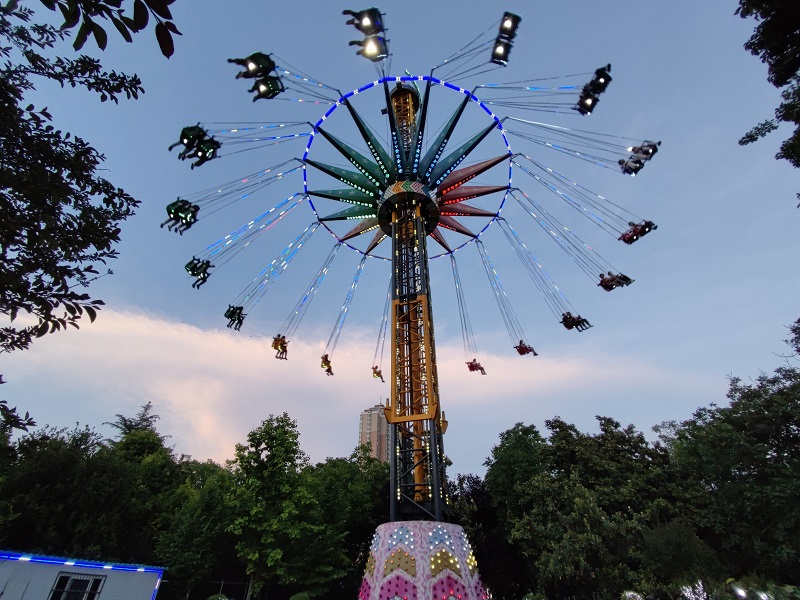
1. Start With the Guest You Want to Serve, Not the Height
A family park with a young visitor profile and a resort with a mixed audience need different things from a tower. The first needs a ride that children can grow into and that parents are willing to ride alongside them; the second needs a landmark that sells photographs and fills a skyline. Both can be served by the same family of equipment, but not by the same size.
The useful sequence is to fix the audience, then the capacity, then the height — not the other way round. A park that starts with a height and works backwards usually ends up with a ride that is either underused on quiet days or overwhelmed at weekends, and an operator cannot fix that with ticketing.
2. Match the Tower Height to Your Site and Skyline
A giant sky flyer ride for sale of 42 m total height lifts passengers to a maximum operating height of roughly 29.5 m. That is high enough to clear surrounding trees, lighting columns and low buildings, and high enough to be seen from outside the park boundary — which is usually the point of buying one.
It is also the reason height restrictions have to be checked before the design is finalised rather than afterwards. Planning limits near airports, protected views, residential proximity rules and local amusement-device regulations all vary, and the practical height a park can install is often smaller than the height it can imagine. Confirm what the site can legally accept, then choose the tower size that fits inside that envelope with margin to spare.
3. Check the Footprint and Foundation Before You Fall in Love With a Model
The footprint is the constraint that most often disqualifies an otherwise suitable ride. The 42 m model has an overall diameter of 14.3 m and requires a clear footprint of about 25 m in diameter, before you allow for the loading queue, safety fencing, service access and the standing area a crane needs on installation day.
Underneath that circle sits the foundation, and it is a designed reinforced-concrete base rather than a pavement slab. The structural engineer needs a geotechnical report for the actual plot, because a ride of this height transfers both vertical load and overturning load into the ground. If the ground is soft, the foundation cost rises quickly — and that cost belongs in the comparison between one size and another.
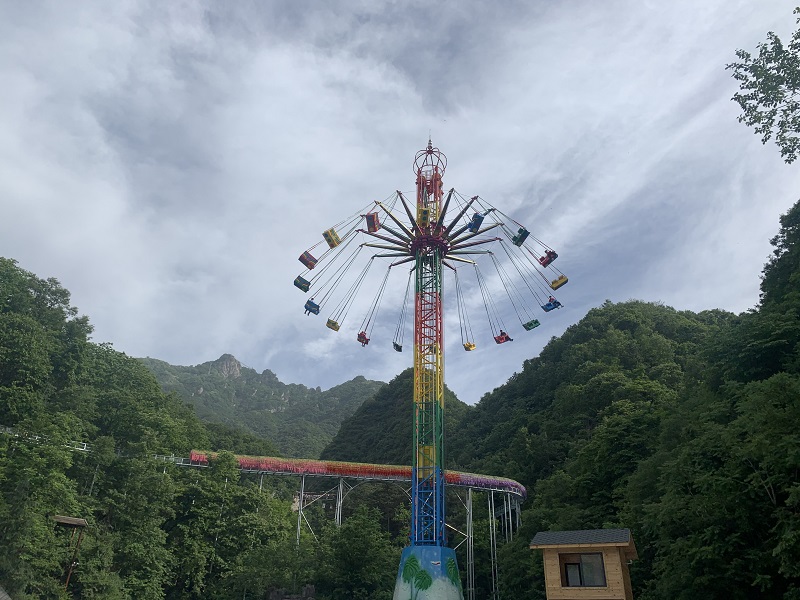
4. Balance Passenger Capacity Against Cycle Time
A commercial sky flyer ride for sale is judged on throughput, and throughput is seats multiplied by cycles per hour. The 42 m configuration carries 32 passengers, and with a cycle of roughly three to four minutes including loading, restraint checks and dispatch, a well-run park can move several hundred guests an hour on a busy day.
Larger towers carry more seats and ride higher, but they also need a bigger footprint, a heavier foundation, more power and a longer loading platform. Smaller towers do the opposite. The right answer for a mid-size park is usually the smallest tower that can absorb the weekend peak without a permanent queue, because an oversized ride is more expensive to buy, to inspect and to operate for the rest of its service life.
5. Confirm the Power Supply and the Operating Envelope
The 42 m model draws around 75 kW, which is modest for a ride of this size but still a load that the site has to be able to deliver reliably. Before ordering, confirm the local voltage, the capacity of the existing transformer, the cable route from the control room and the backup arrangements for bringing passengers down safely in the event of a power interruption.
Wind is the second half of the operating envelope. Every tower ride has a maximum operating wind speed written into its manual, and that figure is derived from the local wind load used in the structural calculations. Coastal sites, exposed hillsides and inland city plots at the same latitude can therefore receive different designs. Give the manufacturer the project country and the exact site, and ask what percentage of the year the ride is expected to remain closed because of wind.
6. Price the Size You Choose, Not Just the Height
Equipment price is the easiest number to compare and the least reliable one. A 42m sky flyer ride for sale from Dinis generally falls between USD 160,000 and USD 185,000 for a standard 32-seat configuration, but the delivered, working attraction carries additional layers: export packing, ocean freight, marine insurance, import duties, foundation construction, crane hire, local installation labour, commissioning, third-party inspection and registration.
Every one of those lines scales with size. A taller tower means a heavier structure, a larger crane, a longer installation window and, in most markets, a higher inspection fee. The correct comparison is therefore not the height you can afford but the size whose total installed cost the local market can repay within a sensible period — which is why park owners usually ask for a quotation that separates the equipment from the project costs.
7. Working with a Manufacturer Directly
Once the size is agreed, the quality of the structure decides the next decade of your maintenance budget. The tower and swing arms are fabricated from steel, and the grade of that steel, the galvanising, the weld quality and the inspection records are what determine how often the ride is taken out of service for repair.
Dinis builds and exports tower rides, ferris wheels, swing chairs and complete park equipment packages from Zhengzhou, China, with more than twenty years of experience in the industry. As a sky flyer ride manufacturer, the company provides technical drawings, foundation load data, packing documentation, shipping support and installation guidance, and it will recommend a tower size based on the site and the guest profile rather than on the largest unit available. Send the plot dimensions, the project country, the local voltage and your target opening date, and Dinis will prepare a configuration and budget proposal.
Current project reference: https://www.dinisdreammyland.com/products/42-m-sky-flyer-ride-for-sale/