The factory price of a carousel is the number that appears in the quotation. The landed cost is the number that appears in your bank account after the ride is standing in your park and ready to run. The gap between them can be 30 to 60 percent, and it is almost always larger than first-time importers expect.
This article breaks the landed cost of a commercial luxury carousel for amusement parks into its components, explains which lines are usually underestimated, and shows how to build a landed-cost sheet before you place the order.

What Landed Cost Actually Includes
| Line | Typical share of landed cost | Notes |
|---|---|---|
| Ex-works ride price | 55 – 70% | 16-seat units are published around USD 7,500 – 9,800; 24-seat around USD 12,000 – 15,600 |
| Inland freight to port | 1 – 3% | Depends on factory location and container size |
| Ocean freight and insurance | 5 – 12% | Varies with route, season and container availability |
| Import duty and taxes | 5 – 25% | Set by the tariff classification in your country |
| Port charges and clearance | 2 – 5% | Handling, documentation, agent fees |
| Inland delivery and lifting | 2 – 6% | Crane and low-loader hire are often forgotten |
| Foundation and electrical works | 8 – 20% | Local civil and electrical contractors |
| Installation and commissioning | 4 – 10% | Supervision, local labour, testing |
The ex-works share falls as the ride gets larger, because freight and local works do not scale with the number of seats in the same way. A 16-seat carousel shipped to a distant market can easily have a landed cost twice its factory price.
Freight: The Line That Moves Most
Carousels ship in parts – platform sections, centre column, canopy ribs, horses and carriages, drive unit and control panel. The packing list determines the number of containers, and that determines freight. Before comparing suppliers, ask each one for a packing list with dimensions, weights and container count. A quote without a packing list cannot be compared on freight.
The carousel importing and shipping timeline also affects cost indirectly: booking a container late in peak season can double the rate. If your opening date is fixed, order early enough to absorb a two to four week shipping delay.
Duty and Tariff Classification
Duty is calculated on the customs value, which includes the goods value plus international freight and insurance under most valuation methods. The tariff code matters more than the invoice description: a carousel classified as amusement park equipment may attract a different rate from one classified as general machinery. Confirm the code with your customs broker before the order is placed, not after the container arrives.
Foundation, Power and Site Works
These costs are local and rarely appear in the supplier quotation. A carousel needs a reinforced concrete foundation sized for the loaded weight and dynamic forces, a power supply sized for the motor and lighting, and a finished safety zone. In many markets the foundation alone costs more than the shipping.
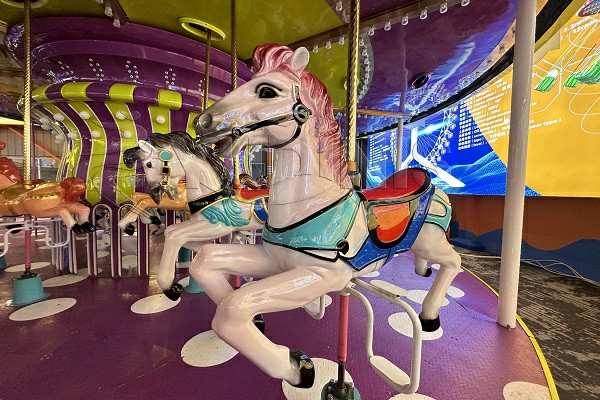
Decorative components such as horses, carriages and canopy panels are commonly produced in fibreglass or FRP, which affects both the weight of the shipment and the maintenance regime after installation.
Installation and Commissioning
Installation supervision is usually charged per day plus travel and accommodation. Confirm how many days the supplier allows, what happens if the site is not ready, and who supplies cranes and scaffolding. A two-week delay caused by an unfinished foundation can cost more than the supervision itself.
Commissioning should include a test run with the specified load, brake checks, emergency stop testing and operator training. Do not release the final payment until those are documented.
Building the Landed-Cost Sheet
- Start with the ex-works price for the exact configuration.
- Add inland freight to port using the packing list.
- Add ocean freight and insurance for the route and container count.
- Apply duty and taxes using the confirmed tariff code.
- Add port charges, clearance and inland delivery with crane hire.
- Add foundation, power and site works from local contractors.
- Add installation supervision, local labour and commissioning.
- Add a ten percent contingency for delays and currency movement.
That total is the number to compare across suppliers. A supplier with a higher factory price but a better packing list and clearer installation scope can easily be cheaper on landed cost.
Capacity and the Business Case
Landed cost only makes sense against revenue. Use the commercial carousel capacity per hour to model peak-day queues, then test whether the ride pays back within three to five seasons at a pessimistic attendance figure. A larger carousel with more capacity is only worth its extra freight and foundation cost if your weekends actually fill it.
Frequently Asked Questions
Is it cheaper to buy FOB or CIF?
CIF is simpler to budget because freight and insurance are included, but FOB often gives you more control and sometimes a lower total if you have a good forwarder.
How much should I budget for duty?
Anywhere from five to twenty-five percent depending on the tariff code and the destination country. Confirm before ordering.
Can the supplier handle installation?
Most supply supervision rather than a full installation crew. Local labour plus a supervising engineer is the usual model, and it is normally the cheapest.
Next Step
Send us your destination port and the configuration you are considering, and we will return a landed-cost sheet using Dinis carousel factory pricing, a detailed packing list and an installation plan. As a park ride equipment supplier, we can also connect you with the civil and electrical scope so the number you approve is the number you actually spend. To start, request a quotation.