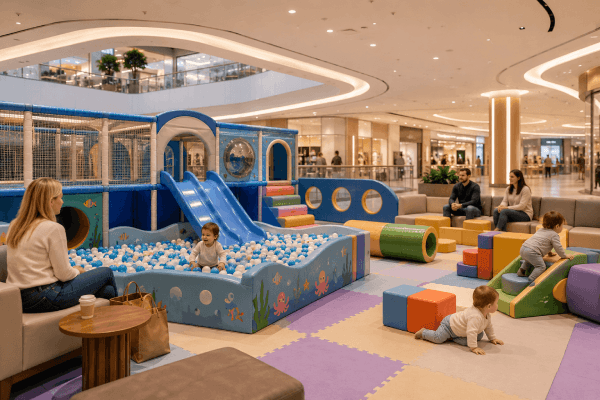
Why Age Separation Decides Whether a Soft Play Zone Works
Most soft play complaints are not really about the equipment; they are about a three-year-old being knocked over by an eight-year-old in the same ball pool. Separating age groups is therefore a layout decision rather than a finishing touch. A buyer who asks for a soft play age zone layout design often starts with padding specifications, yet the zoning decides how the room behaves on a wet Saturday: where children queue, where parents stand, and how quickly a supervisor can cross the floor. Settling the age bands before a single panel is ordered saves more money than any discount on equipment ever will.
Three Bands Instead of Two: Toddlers, Juniors and Older Children
The workable answer is three bands rather than two. Toddlers need enclosed, low-level play with soft ramps and no drop higher than a knee. Younger children want climbing, crawling and small slides with an obvious route back to the entrance. Older children need height, speed and challenge, and they will invent their own risks if the equipment offers none. Treating soft play age group separation as three separate environments, each with its own entry and exit, keeps fast traffic away from slow traffic without making the whole room feel fenced and unfriendly.
Boundaries a Child Can Read Without Hiding a Supervisor
Zones should be divided by things a child can read at a glance. Low walls, a change of floor colour, rope gates and a different ceiling height all do that job while keeping sightlines open. What fails is a solid partition tall enough to hide a child from the till. A soft play area installation solves the same problem with sculpted shapes and colour instead of walls, so each area has its own identity while an adult sitting in the middle of the building can still watch three zones at once.
Sightlines, Seating and the Supervision Diagonal
Supervision decides how much open floor you can keep. If a supervisor has to walk the length of the building to reach the toddler corner, the layout is wrong. Put the youngest zone nearest the entrance and the seating, keep one unobstructed diagonal across the room, and arrange benches so adults look across the play areas rather than at their backs. Bringing a Miland indoor playground manufacturer into the layout stage keeps those sightlines in the drawing instead of discovering them after installation, when moving a climbing frame is no longer cheap.
What Toddler Development Says About Low, Enclosed Play
Matching play to a child’s stage is not a new idea. Standard descriptions of the toddler years highlight short attention spans, uneven balance and a strong need to stay within sight of a familiar adult, which is exactly why toddler zones are built low, enclosed and close to seating. Older children follow the opposite pattern, seeking height, speed and repetition until a move is mastered. Designing around those two realities is more reliable than designing around a theme, because a theme sells the first visit while a well-banded layout brings families back on a rainy afternoon.
Laying Out the Zones the Way Families Meet Them
Draw the plan as three bands, mark the doors, then confirm that every zone can be reached, watched and cleaned without crossing another zone. Check entrapment gaps and fall heights against the flooring specification, agree who inspects the padding each morning, and keep one empty corner for whatever the toddlers ignore and their older siblings queue for. Zones decide the equipment list, not the other way around, and a room that respects age groups stays manageable even on the busiest Saturday. Categories: Soft Play, Commercial Playground Equipment, Indoor Playground, Playground Safety, Toddler Play Area, Family Entertainment Center. Tags: soft play zoning, age group separation, indoor playground layout, toddler play area, playground sightlines, family entertainment center. https://www.milandplay.com/product/soft-play-and-toddler-areas-for-indoor-playgrounds/